How to Use an Ovulation Test: When to Start, How to Read It
An ovulation test (OPK) detects the surge of luteinising hormone (LH) in your urine that happens about one to one and a half days before ovulation. Start testing three to five days before you expect to ovulate, test at the same time each day, and treat a positive result as a sign that your most fertile days are happening now.
Key takeaways
- Ovulation tests detect the LH surge, which usually comes 1 to 1½ days before ovulation.
- Start testing 3–5 days before your expected ovulation, based on your average cycle length.
- Test at the same time every day and avoid drinking a lot beforehand.
- A positive test means your most fertile days are now: the egg is released soon after.
- OPKs help you plan pregnancy but are not reliable for preventing pregnancy.
What does an ovulation test detect?
Ovulation tests, also called ovulation predictor kits (OPKs), measure luteinising hormone (LH) in your urine. LH rises sharply in the middle of your cycle, and this surge is what triggers your ovary to release an egg. According to the US Food and Drug Administration, the LH surge usually happens 1 to 1½ days before ovulation (FDA).
Some newer tests also measure an oestrogen breakdown product (E3G), which starts rising a little earlier. This can show you a few extra fertile days before the LH surge, when cervical mucus also becomes thinner and more slippery.
Because the egg survives only about 24 hours after release while sperm can survive for several days, the days just before and around the LH surge are your most fertile. Our guide to the fertile window vs ovulation day explains why timing matters so much.
When to take an ovulation test
Starting at the right time is the most important part. If you start too late, you can miss the surge completely, and the FDA notes that results are unreliable if you do not begin at the proper point in your cycle.
- Work out your average cycle length from your last few periods (day 1 is the first day of bleeding).
- Estimate ovulation as about 14 days before your next expected period. For a 28-day cycle that is around day 14; for a 32-day cycle, around day 18.
- Start testing 3 to 5 days before that day (Cleveland Clinic).
- Keep testing daily until you get a positive result.
If your cycles are irregular
With irregular cycles, base your start day on your shortest recent cycle so you don't miss an early surge, and expect to use more tests. Watching your cervical mucus helps too: when it turns clear and stretchy, a surge is usually close. Our article on signs of ovulation shows what to look for.
How to use an ovulation test step by step
- Read the leaflet first. Brands differ in how long you hold the test in your urine and how long to wait for the result.
- Choose a consistent time of day. Cleveland Clinic suggests testing first thing in the morning, when urine is more concentrated; some kits recommend a different time, so follow your kit's instructions and stick to the same time each day.
- Avoid drinking a lot just before testing, because a lot of liquid dilutes your urine and can hide the surge.
- Collect your sample: hold the tip in your urine stream or dip it into a clean cup of urine.
- Wait for the result, usually about 5 minutes, and read it within the time stated on the leaflet.
- Log the result the same day, along with your cervical mucus, so you can compare cycles.
Used correctly, the FDA says these tests detect the LH surge reliably about 9 times out of 10.
How to read an ovulation test result
Line strips
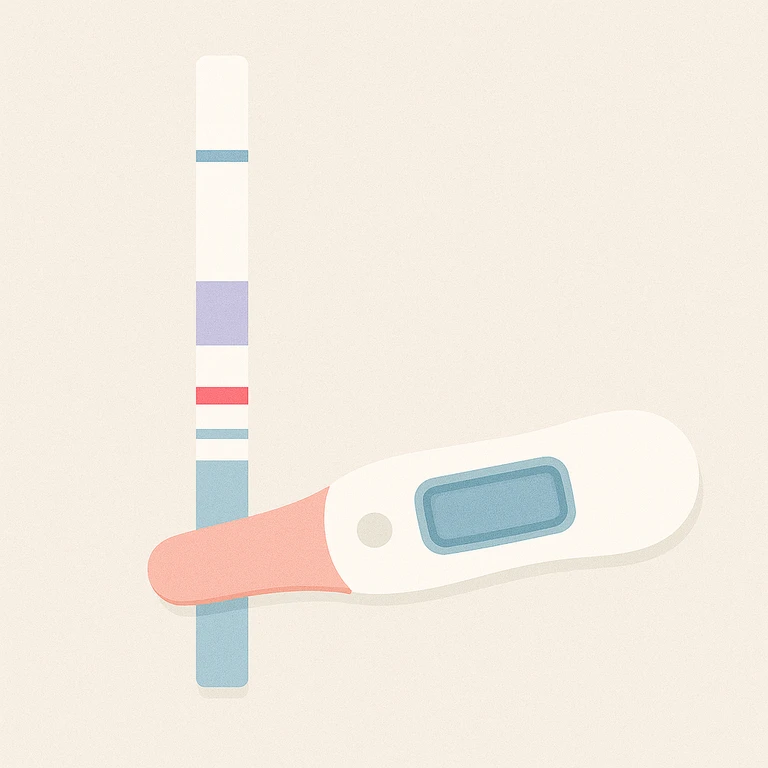
Most strips have a control line, which should always appear, and a test line. The test line gets darker as you approach your surge. With most brands a result is positive when the test line is as dark as or darker than the control line, but always check your kit's leaflet, because products differ. A faint test line on its own usually means the surge has not started yet.
Digital tests
Digital tests show a symbol, such as a smiley face, instead of lines, which removes the guesswork. Some dual-hormone digital tests show a "high fertility" result first (rising oestrogen) and then "peak fertility" (the LH surge).
What a positive ovulation test means
A positive ovulation test means the LH surge has started and ovulation is likely to follow within about a day or so. This and the following day are your most fertile time. If you are trying to conceive, having sex on the day of the positive test and the next day gives you the best timing. Since sperm can survive for several days, sex in the days before the positive result also counts.
Common ovulation test problems
- Never getting a positive: you may be starting too late, testing with diluted urine, or have a very short surge. Try testing twice a day around your expected ovulation. If you never see a positive over several cycles, talk to a doctor.
- Several positives in one cycle: this can happen with polycystic ovary syndrome (PCOS), where LH levels can stay high or surge more than once, making tests harder to interpret.
- Positive test but no temperature rise: an LH surge does not always mean an egg was released. If this keeps happening, it is worth getting checked.
- Using fertility medication: some fertility drugs contain LH or hCG and can cause misleading results. Ask your clinic how to test.
Ovulation tests also cannot tell you whether you are pregnant, how good your egg quality is, or whether there is a fertility problem.
Ovulation tests and contraception
Ovulation tests are designed to help you plan a pregnancy. The FDA states they are not reliable for preventing pregnancy, because sperm can survive for days before the surge is detected. If you want to avoid pregnancy, speak to a doctor, nurse or pharmacist about contraception that suits you.
Track your ovulation test results
Results make much more sense when you can see them over several cycles. Logging each test in a period tracker like Femininity, alongside cervical mucus and basal body temperature, shows you on which cycle day your surge usually happens. After a few months, you can start testing later and use fewer strips.
When to see a doctor
- You never get a positive ovulation test over several cycles.
- Your periods are very irregular, absent for 3 months or more, or cycles are shorter than 21 or longer than 35 days.
- You get many positive tests in the same cycle, which can be a sign of PCOS.
- You have been trying to conceive for 12 months (or 6 months if you are 35 or older) without success.
- You have severe pelvic pain, or pain with a positive pregnancy test (seek urgent care).
Frequently asked questions
What time of day is best to take an ovulation test?
Test at the same time every day and follow your kit's leaflet. Cleveland Clinic suggests morning, when urine is more concentrated, while some brands recommend later in the day. Avoid drinking a lot just before testing.
How long after a positive ovulation test do you ovulate?
The LH surge usually happens about one to one and a half days before ovulation, according to the FDA. So ovulation typically follows within roughly a day or so of your first positive test.
What does a faint line on an ovulation test mean?
A faint test line is usually negative. Most brands count a result as positive only when the test line is as dark as or darker than the control line. Keep testing daily.
Can I use an ovulation test as a pregnancy test?
No. Ovulation tests are designed to detect LH, not pregnancy. Use a pregnancy test from about the day your period is due.
How many days should I test for?
Start 3 to 5 days before your expected ovulation and continue daily until you get a positive result. With irregular cycles, you may need to test for longer.
Should I test twice a day?
Testing once a day works for many people, but some surges are short. If you keep missing a positive, testing twice a day around your expected ovulation can help.
Do ovulation tests work if I have PCOS?
They can be harder to interpret with PCOS because LH may be raised or surge more than once. Combining tests with temperature charting and talking to a doctor is often more useful.
Are digital ovulation tests better than strips?
Digital tests are easier to read, but basic strips work just as well for detecting the LH surge. Choose whichever you find easiest to use consistently.
Track it in Femininity
Log your symptoms, see your cycle phases and get tips like this one at the right moment. Free, private and works offline.

Sources
- FDA – Ovulation (urine test)
- Cleveland Clinic – Ovulation predictor kits: what to know
- Cleveland Clinic – Ovulation
This article is for general information only and is not a substitute for professional medical advice, diagnosis or treatment. Always talk to a doctor or midwife about your own health.